Table of Contents
- What Direct Trade Coffee Alternatives Actually Mean for Home Brewers
-
What to Look for in a Direct Trade Coffee Subscription
- 1. Verifiable sourcing fields, not storytelling
- 2. Price transparency relative to the commodity market
- 3. Roast date, not best-by date
- 4. Subscription mechanics that respect the buyer
- 5. Roast variety and origin rotation
- 6. Shipping logistics and packaging
- 7. Sustainability claims you can actually check
- The Benefits of Anaerobic Fermentation in Coffee
- How to Support Small Coffee Producers Through Your Subscription
- Home Brewing Equipment Compatibility With Fermented Coffees
- Pricing, Shipping Footprint, and Value in Direct Trade Coffee
- Frequently Asked Questions
Last Updated: September 12, 2026
What Direct Trade Coffee Alternatives Actually Mean for Home Brewers
Direct trade coffee is a sourcing model in which a roaster buys from named producers at negotiated prices, outside the certified fair trade and organic systems, usually with published farm-level detail. The harder question is what "direct trade coffee alternatives for home" actually gets you: a bag of green coffee with a producer's name on it, or a cup you can trace to a specific fermentation protocol, harvest, and station.
That distinction matters because transparency claims are cheap. Almost every specialty roaster prints a farm name on the bag; far fewer can tell you the varietal, altitude, fermentation duration, and who processed the lot.
Below, we break down what separates a real direct trade program from marketing copy, how anaerobic fermentation changes the flavor in the cup, and which brewing setups handle these coffees well.
What to Look for in a Direct Trade Coffee Subscription
A direct trade coffee subscription is a recurring delivery of coffee sourced through named producer relationships, and the best ones publish enough detail that you can verify the sourcing yourself. The real filter is whether the roaster gives you the fields you need to check the claim, and whether the subscription mechanics respect your time and counter space.
Here is the full checklist, ordered from most to least diagnostic.
1. Verifiable sourcing fields, not storytelling
A farm name alone is decoration. A verifiable listing includes the producer or family name, farm or washing station, region, varietal, altitude, processing method, fermentation duration if applicable, and harvest year. A lot number is the strongest signal, tying one bag to one production run and one set of green coffee records.
If a roaster publishes farm names but not varietals or harvest years, they are buying through an importer and repeating the importer's copy. That is not a crime, but it is not direct trade in any meaningful sense.
2. Price transparency relative to the commodity market
The Commodity Coffee price is published daily on the Intercontinental Exchange and is the baseline against which specialty premiums are measured. A credible direct trade roaster can tell you the premium range over the commodity price, or the farmgate price in the producing country's currency.
Intercontinental Exchange coffee futures pricing and contract specifications publishes the reference price that specialty premiums are measured against.
3. Roast date, not best-by date
Coffee peaks within days of roasting and declines steadily after. A roasted-on date is the only freshness guarantee that means anything. Best-by dates are set by the roaster and can be months out. If a bag has no roast date, assume the coffee is older than you would like.
4. Subscription mechanics that respect the buyer
This is where most listicles get vague. The specifics that matter:
- Frequency options. Weekly, biweekly, and monthly are standard. A program that only offers monthly forces you to over-order or run out.
- Skip and pause without penalty. You should be able to skip a shipment the week before it ships, not email support and hope.
- Cancel in the account dashboard. If cancellation requires a phone call or a retention chat, the roaster is betting on friction, not quality.
- Bag size options. 10oz (about 283g) is the specialty standard. 12oz and 16oz bags exist but change the per-cup math. A 10oz bag at 18g per dose yields roughly 15 to 16 brews.
- Grind selection at checkout. Whole bean is the default for anyone with a grinder. If you need ground, choose the grind that matches your brewer, not the generic "drip" option.
5. Roast variety and origin rotation
A subscription that ships the same washed Colombian every month is a coffee club, not a discovery program. Look for roasters who rotate origins and processes on a published schedule, so you can plan around what is coming and learn how terroir and process interact.
6. Shipping logistics and packaging
Two things to check before you subscribe:
- Roast-to-ship window. Coffee should ship within 48 hours of roasting, not sit in a warehouse. Ask or check the FAQ.
- Packaging. One-way valve bags with a degassing valve preserve freshness. Compostable or recyclable packaging is increasingly common and worth prioritizing if shipping footprint matters to you.
7. Sustainability claims you can actually check
"Sustainable" is unregulated in coffee marketing. The checkable claims are narrower: published farmgate prices, multi-year producer relationships, lot-level traceability, and compostable or curbside-recyclable packaging. A carbon-neutral shipping claim should name the offset or carrier program used.
The Benefits of Anaerobic Fermentation in Coffee
Anaerobic fermentation in coffee is a controlled process in which whole cherries or depulped beans are sealed in oxygen-free tanks for a set number of hours, letting specific yeasts and bacteria develop flavor compounds open-air fermentation can't produce consistently. The result is fruit-forward cups with layered sweetness, and, critically, repeatability.
That repeatability is the whole point. A wild natural ferment depends on whatever microbes happen to be present; a sealed ferment at a controlled temperature and documented duration can be reproduced lot after lot.
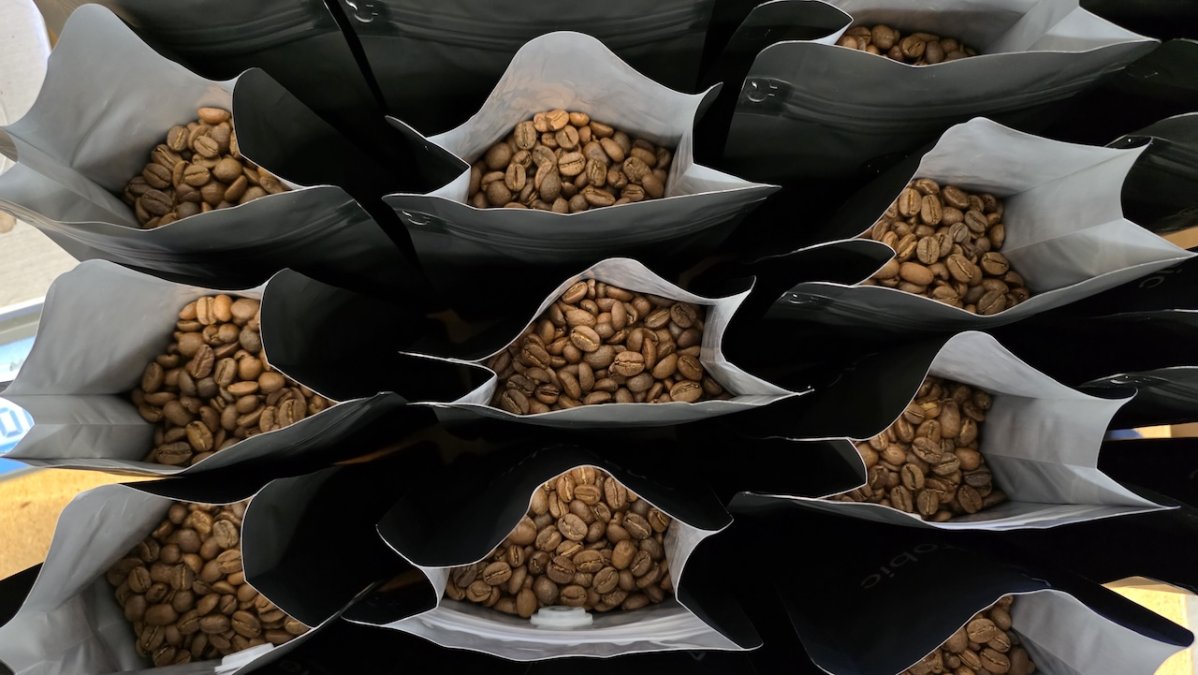
Close-up of light roasted whole coffee beans.
Anaerobic is built entirely around this method. Its lineup runs from a 48-hour ferment (Uganda Coffee Yards, tasting of chocolate fudge and toffee) to a 96-hour ferment (the same Uganda cherries, now reading guava, overripe peach, and mulled wine). Same farms, same varietals, same processing method. One variable changed: the clock.
How to Support Small Coffee Producers Through Your Subscription
The most effective way to support small coffee producers is to buy coffee that names them, pays them outside commodity pricing, and rewards quality at the farm level. Three levers:
- Buy from roasters who publish producer names. A named producer has use. An anonymous "smallholder blend" does not.
- Pay attention to lot size. Microlots command higher prices because they represent a producer's best work. A Reserve lot of roughly 213 bags supports a family operation far more directly than a commodity blend.
- Choose roasters with multi-year relationships. A single purchase is a transaction. A recurring relationship is income stability.
Reading a Producer Profile: What Named Farms Tell You
A producer profile tells you whether a roaster actually knows the farm or just bought through an importer. Look for the producer's name, farm or station, region, altitude, and competition history.
Anaerobic's Ethiopia Bursa lots come from Mulugeta Muntasha, whose station processed four of the top ten lots in Ethiopia's 2022 Cup of Excellence. Its Colombia Nativo Nogales comes from the Hernández family at Finca Los Nogales, which took first place in Colombia's 2005 Cup of Excellence.
Cup of Excellence competition results and producer records maintains the public archive where those placements can be checked.
Home Brewing Equipment Compatibility With Fermented Coffees
Fermented coffees brew on the same equipment as any other specialty coffee, but respond differently to grind and temperature. A few adjustments:
- Pour-over (V60, Chemex, Kalita): Best for washed and lighter anaerobic lots. Start at a medium-fine grind and 200-205°F water. These methods reward clarity.
- Immersion (French press, AeroPress): Best for heavy fruit-forward naturals. A slightly coarser grind and a 3-4 minute steep keeps the sweetness from turning muddy.
- Espresso: Workable but demanding. Anaerobic naturals can be finicky on pressure profiling, and a 1:2 ratio often pulls better than a 1:1.5.
- Grinder: The single upgrade that matters most. A burr grinder with consistent particle distribution will do more for these coffees than any brewer change.
If you're coming from a standard drip setup, expect the biggest gains from a burr grinder and a scale before you spend on a new brewer.
Pricing, Shipping Footprint, and Value in Direct Trade Coffee
Direct trade coffee costs more because the supply chain is shorter and the lots are smaller. The useful question is not whether it costs more, but what you pay per cup and what the shipping footprint of a recurring delivery looks like.
What the numbers look like
Anaerobic's whole-bean lots sit at $32.00 for single-origin coffees and $45.00 for Reserve microlots, with Discovery Sets at $81.80 for The Beyond and $92.20 for The Cellar. Samples run $12.00 for 50 grams, enough for three or four brews.

Option |
Price |
Best For |
Format |
|---|---|---|---|
Coffee Sample · 50 g |
$12.00 |
Testing a lot before committing |
Single lot, 3-4 brews |
Colombia Guamo · 36+96h |
$32.00 |
Everyday anaerobic drinking |
Whole bean, 10oz |
Uganda Coffee Yards · 48h |
$32.00 |
Dessert-sweet, approachable |
Whole bean, 10oz |
Uganda Coffee Yards · 96h |
$32.00 |
Fruit-forward comparison |
Whole bean, 10oz |
Ethiopia Bursa · Washed G1 |
$32.00 |
Clarity and structure |
Whole bean, 10oz |
Ethiopia Bursa · Anaerobic G1 |
$32.00 |
Wine-like, delicate fruit |
Whole bean, 10oz |
Colombia Papayo Jungle |
$45.00 |
Rare cultivar, tropical fruit |
Whole bean, Reserve |
Colombia Nativo Nogales |
$45.00 |
Mosto ferment, floral |
Whole bean, Reserve |
$81.80 |
Process comparison set |
Three 10oz bags |
|
The Cellar |
$92.20 |
Rarest lots, three origins |
Three 10oz bags |
The per-cup math that actually matters
A 10oz bag is about 283 grams. At a standard 18-gram dose, that is roughly 15 to 16 brews per bag: about $2.00 to $2.15 per cup at $32.00, and roughly $2.80 to $3.00 per cup at $45.00 for a Reserve lot.
Put that next to a $6.00 to $7.00 cafe pour-over and the subscription math changes. The relevant benchmark is not the cheapest coffee you can buy, but the coffee you would otherwise drink.
A 50-gram sample at $12.00 is about $0.24 per gram, which is more per gram than a full bag. That is the point. Samples are for deciding whether a lot is worth a full bag, not for routine drinking.
Shipping logistics and the roast-to-door window
Free shipping applies on orders over $50, and subscription plans save 10 to 15 percent. Coffee ships within 48 hours of roasting. That window matters more than shipping speed: a two-day transit puts the coffee in your grinder at roughly four days post-roast, close to ideal for most anaerobic and natural lots.
If you are ordering multiple bags, consolidate into one shipment. Consolidated deliveries reduce packaging and transport per bag, and all your coffee arrives at the same point in its freshness curve.
The shipping footprint question most articles skip
Recurring coffee delivery has a real environmental cost, best understood in three parts: green coffee ocean freight, roastery packaging, and last-mile delivery.
- Green coffee freight. Coffee travels by container ship from producing countries. Ocean freight is the lowest-emission mode per ton-mile, and it is not the part of the chain you can meaningfully change as a buyer.
- Packaging. One-way valve bags are the specialty standard. Compostable and curbside-recyclable options exist and are worth prioritizing. A bag that cannot be recycled or composted goes to landfill, and a monthly subscriber generates twelve of them a year.
- Last-mile delivery. This is the part you control. A single monthly shipment beats four weekly ones. Combining coffee with other household orders, or choosing a carrier with a published emissions-reduction program, lowers the per-bag footprint.
U.S. Environmental Protection Agency guidance on reducing packaging waste in e-commerce outlines how consolidated deliveries and reduced packaging lower the footprint of recurring shipments.
Value, defined honestly
Value in direct trade coffee is not the lowest price per pound. It is published sourcing detail, documented process, roast-date freshness, and a per-cup cost defensible against the cafe alternative. A $32.00 bag yielding 15 excellent cups beats a $16.00 bag yielding 15 cups you drink out of habit.
Frequently Asked Questions
What is the difference between Fair Trade and direct trade coffee?
Fair Trade certification sets a minimum price floor and requires cooperatives to meet social and environmental standards, verified by a third-party certifier. Direct trade coffee skips that layer: roasters buy straight from named producers or estates, often paying above commodity rates and visiting farms themselves. The trade-off is that direct trade has no universal certifying body, so transparency depends on how much the roaster publishes about the specific farm, lot, and price paid.
How can I verify if a coffee brand is truly direct trade?
Look for named producers, not just a country of origin. A roaster practicing direct trade will list the farm or estate, the region, the altitude, the varietal, and often the lot number. Anaerobic, for example, names El Vergel Estate in Tolima and Finca Los Nogales in Huila, and publishes harvest years and process details. If a bag only says 'Colombia' or 'Ethiopia' with no producer name, the sourcing claim is hard to check.
What are the benefits of buying small-batch anaerobic coffee for home brewing?
Small-batch roasting means the coffee is roasted in small rounds and often sealed the same day, so it reaches you closer to peak flavor. Anaerobic fermentation adds another layer: controlled oxygen-free fermentation develops specific fruit notes on purpose rather than leaving them to chance. The result is a cup with predictable tasting notes, like the strawberry and mango in Colombia Papayo Jungle, instead of the inconsistent funk that poorly controlled fermentation produces.
Is direct trade coffee more expensive than standard subscription services?
Yes, typically. Direct trade lots cost more because roasters pay producers above commodity rates and absorb the cost of small-batch roasting and faster shipping. Anaerobic's single-origin bags start at $32.00, with Reserve microlots at $45.00 and Discovery Sets from $81.80. Subscriptions save 10-15% and orders over $50 ship free, which narrows the gap against mass-market subscriptions once you factor in freshness and traceability.
Will I be able to brew complex fermented coffees without professional equipment?
Yes. A burr grinder, a scale, and a pour-over cone or French press are enough to dial in anaerobic coffees. The main adjustment is grind size: fermented naturals extract quickly, so start slightly coarser than you would for a washed coffee and adjust from taste. Anaerobic's lots are roasted to reveal flavor rather than rescue, so water just off boil (around 200-205°F) works well for most home setups.