Table of Contents
- What Is Controlled Fermentation in Coffee?
- Why Fermented Coffee Behaves Differently During Extraction
- What You'll Need to Dial In Fermented Coffee
- Step 1: Find the Best Grind Size for Fermented Coffee
- Step 2: Set Your Brew Ratio and Dose
- Step 3: Measure Shot Time and Adjust for Flavor
- Anaerobic Coffee Brewing Tips for Consistent Results
- Common Mistakes to Avoid When Dialing In Fermented Coffee
- Frequently Asked Questions
Last Updated: September 12, 2026
What Is Controlled Fermentation in Coffee?
Controlled fermentation in coffee is the deliberate management of temperature, time, oxygen exposure, and microbial activity during the cherry or mucilage stage to steer flavor development rather than leave it to chance. In sealed-tank anaerobic lots, producers hold cherries in airtight vessels for a set window, often 96 hours, so sugars and acids break down predictably (PubMed).
That distinction matters when you brew. A lot fermented with logged parameters gives you a repeatable starting point. A wild-fermented lot gives you a moving target. At Anaerobic, we source from producers who record those parameters, which is the only reason a dialing-in guide like this one can exist at all.
Traditional washed coffee gives you a fairly linear extraction curve; fermented coffee does not. Below, we'll show you exactly how to dial in fermented coffee with a structured process: grind, dose, ratio, time, taste, repeat. One warning first: most espresso guides will actively mislead you here.
Why Fermented Coffee Behaves Differently During Extraction
Fermented coffees extract faster and less predictably than washed coffees because fermentation has already pre-digested part of the bean's structure. Extended anaerobic fermentation converts sugars and organic acids inside the cherry, so by the time you grind it, some of the work water normally does has already happened.
The practical consequences show up in three places:
- Higher solubility. Fermented beans give up dissolved solids more readily, so a grind that works for a washed Ethiopian will likely over-extract a co-fermented one.
- Sharper flavor peaks. Sourness and bitterness arrive closer together on the dial. Small grind changes produce large taste swings.
- More fragile aromatics. The volatile compounds that create those strawberry and papaya notes degrade quickly at high temperature.
This is where most people give up and decide fermented coffee is just "funky." It usually isn't the bean. It's an extraction curve that was never calibrated for it.

What You'll Need to Dial In Fermented Coffee
You don't need a professional setup, just four things that give you control and one that gives you feedback.
Minimum kit:
- A burr grinder with numbered or marked adjustment steps
- A digital scale accurate to 0.1 g
- An espresso machine or brewer with stable temperature control
- A timer, separate from your phone
- A notebook or app for logging shots
Optional but genuinely useful:
- A bottomless portafilter, so you can see channeling as it happens
- A refractometer, if you want to measure total dissolved solids rather than taste alone
- A distribution tool and calibrated tamper
The refractometer is optional-but-transformative: it converts "this tastes a bit sharp" into a number you can compare against your last shot. On fermented lots, where the sweet spot is narrow, that comparison is worth more than on a washed coffee.
Step 1: Find the Best Grind Size for Fermented Coffee
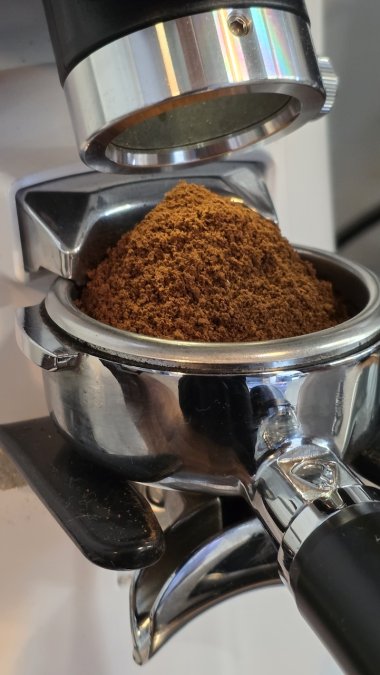
The best grind size for fermented coffee starts finer than you'd expect for the roast level, then backs off. Because fermented beans are more soluble, many brewers assume they need a coarser grind, but the opposite is often true at the start: begin around a medium-fine setting, pull a shot, and adjust based on flow rather than flavor alone.
Why fermented beans need a different grind target
Co-fermented and anaerobic lots are typically denser and more soluble than washed coffees of the same roast level. Fermentation has already broken down part of the mucilage and cell structure, so water reaches the soluble material faster, and the beans often finish roasting at a slightly different density, which changes how they fracture in the burrs. A grind setting that produces a balanced 1:2 shot on a washed Ethiopian will usually run fast and taste sharp on a co-fermented lot from the same roaster.
That is why the starting point is finer, not coarser. You are compensating for higher solubility by slowing the flow, not by grinding coarser to speed it up.

Calibrate the grinder before you touch the dial
Grinder calibration differences between machines are enormous, so a setting from a forum post is meaningless on your equipment. Before you dial in a fermented lot:
- Zero the grinder and note where the burrs touch.
- Write down the numeric setting you are using, not a word like "medium."
- Pull one shot at that setting and record the flow rate in grams per second, not just total time.
A useful reference: a well-behaved 18 g dose at a 1:2 ratio typically flows at roughly 1.2 to 1.5 g per second. If your fermented shot runs at 2 g per second or faster, you are almost certainly too coarse regardless of what the clock says.
Flat burrs vs conical burrs on high-density fermented beans
This matters more on fermented coffee than on washed coffee.
- Flat burrs produce a narrower particle distribution with fewer fines, so on a dense, highly soluble fermented bean the sweet spot is real but small. Move in single-step increments, a one-step change can shift the shot by several seconds, and expect flat burrs to highlight clean, fruit-forward acids.
- Conical burrs produce a wider distribution with more fines, which can clog the puck and cause channeling that reads as muddy and over-extracted even when your grind setting looks correct. Conical users often grind slightly coarser than flat-burr users on the same bean and compensate with a longer ratio rather than a finer grind.
Two brewers on the same co-fermented lot, one flat, one conical, will land two to four numbered steps apart and still get comparable cups. Do not copy a setting across burr types.
Work in small increments
Move one or two steps at a time, not five, fermented lots punish big jumps because the flavor window is narrow. If you overshoot, go back to your last logged setting rather than correcting forward.
Step 2: Set Your Brew Ratio and Dose
Start with a 1:2 ratio by weight and a dose that fills your basket correctly, typically 18 g in and 36 g out for a standard double basket. Fermented coffees reward precision here because the flavor window is narrower. Weigh your output on a scale, not by eye or volume: a 2 g variance in yield is enough to shift a fermented shot from bright to muddy.
Parameter |
Starting Point |
Adjust If Sour |
Adjust If Bitter |
|---|---|---|---|
Dose |
18 g |
Increase slightly |
Decrease slightly |
Yield |
36 g |
Increase yield |
Decrease yield |
Ratio |
1:2 |
Toward 1:2.5 - 1:3 |
Keep ratio - drop water temp |
Grind |
Medium-fine |
Go finer |
Go coarser |
Change one variable per shot. If you change dose and grind together, you learn nothing.
Step 3: Measure Shot Time and Adjust for Flavor
Shot time is your fastest diagnostic, but not your target. Aim for a 25-30 second window as a baseline, then let taste override the clock, a fermented coffee that tastes balanced at 22 seconds is correctly dialed in, regardless of what a recipe says. Fermented coffees rarely fail in a way the clock can describe, they fail in the cup and in the pour, so read both or you'll keep adjusting the wrong variable.
What under-extraction actually looks like on a fermented lot
Under-extracted fermented coffee does not always taste simply sour. Because fermentation has already produced organic acids, the under-extracted cup often reads as:
- Thin and tea-like body, with the fruit notes sitting high and separate from the rest of the cup rather than integrated.
- A sharp, almost vinegar-adjacent acidity on the front of the tongue that fades quickly instead of lingering.
- A hollow mid-palate, you get aroma and acid but no sweetness bridging them.
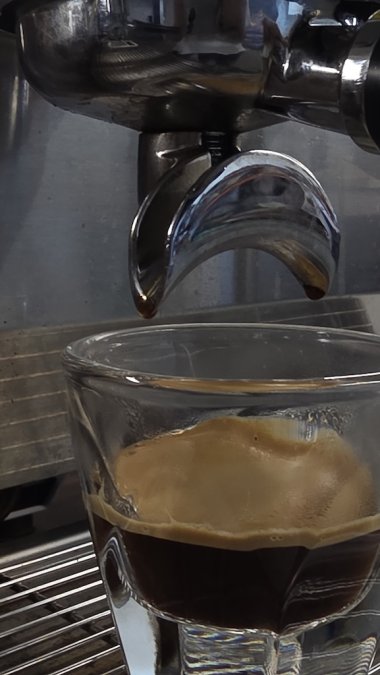
- A fast, pale pour from a bottomless portafilter: blonding starts within the first few seconds and the stream never thickens.
What over-extraction actually looks like on a fermented lot
Over-extracted fermented coffee is where most brewers get confused, because it can still taste fruity. The tells are:
- A drying, chalky finish that coats the back of the tongue and lingers past the swallow.
- Muddled fruit, the strawberry or papaya note is present but blurry, like it is behind glass.
- A bitter edge that arrives late, often after the cup has cooled for a minute or two.
- A slow, dark pour with visible channeling: the stream splits, one side runs pale while the other stays dark, and total time stretches past 35 seconds.
The overlap problem
Fermented coffees often show both at once, sharp acidity up front and a drying finish at the back. That usually means the puck is channeling: part of the bed is under-extracted and part over-extracted, and you're tasting both in the same sip. When you see that pattern, stop adjusting grind and check distribution, tamp level, and dose fit in the basket.
Here is the decision sequence, revised for fermented lots:
- Shot runs under 20 seconds, tastes thin and sharp, pours pale early. Grind finer.
- Shot runs over 35 seconds, tastes drying and bitter, pours unevenly. Check puck prep before going coarser.
- Shot time is in range but tastes hollow with no sweetness. Increase yield slightly, fermented lots often need a longer ratio to bring sweetness forward.
- Shot time is in range but tastes harsh and astringent. Drop brew temperature a degree or two. Fermented aromatics are fragile at high heat.
- Everything is in range and it still tastes flat. The bean may need more rest, not more adjustment.
Anaerobic Coffee Brewing Tips for Consistent Results
Consistency comes from controlling the variables you can and accepting the ones you can't. Anaerobic coffee brewing tips that hold up tend to be boring: log everything, change one thing at a time, and rest beans after roast.
Three specifics that matter for fermented lots:
- Rest the beans. Fermented coffees often taste sharp and disjointed in the first days after roast and settle noticeably after a week or more. If a new bag tastes wrong, wait before you blame your grind.
- Watch your water. Water chemistry affects how readily fermented compounds dissolve. Hard water can flatten the fruit notes; very soft water can make the acidity read thin.
- Keep temperature stable. Small temperature drift during a shot changes extraction yield more on a fermented coffee than on a washed one.
For a baseline on extraction measurement, the [Specialty Coffee(/blogs/news/how-to-identify-specialty-coffee-processing-styles) Association's brewing standards | sca.coffee] set out the reference ranges most roasters and cafés work from, including the 18-22% extraction yield band that guides most dialing-in decisions.
Common Mistakes to Avoid When Dialing In Fermented Coffee
The most common mistake is treating a fermented coffee like a washed coffee with a different flavor label. The extraction curve is different, the sweet spot is narrower, and the penalties for guessing are larger.
Four errors I see repeatedly:
- Changing multiple variables at once. You'll get a better shot and have no idea why. Then you can't repeat it.
- Trusting a recipe from a different grinder. Grinder calibration differences make shared settings close to useless. Use them as a direction, not a number.
- Judging a new bag on day one. Fermented lots frequently need rest. A coffee that tastes muddled at day two may be excellent at day ten.
- Ignoring the visual cues. A bottomless portafilter shows you channeling, uneven flow, and blonding in real time. If the flow starts fast and turns pale early, you have a distribution problem, not a grind problem.
That last point is the gap most guides skip. Visual and sensory cues tell you what the numbers can't: whether the puck is behaving evenly. Numbers describe the result. The pour describes the cause.
If you want a controlled starting point rather than a lottery, Anaerobic's single-origin anaerobic lots ship with the fermentation parameters documented, so you know what you're dialing toward. The Specialty Coffee Association's cupping protocols are also worth reading if you want a structured vocabulary for tasting what you're adjusting.
Dialing in fermented coffee is a calibration problem, not a talent problem, and it becomes routine once you have a controlled bean and a repeatable method. The hard part is starting from a lot whose fermentation was actually measured, because no amount of technique rescues a coffee with no defined baseline. Anaerobic sources from producers who log their fermentation windows and roasts small batches to reveal those flavors rather than smooth them over, with freshly roasted coffee shipped within 48 hours and free shipping on orders over $50. Start with a discovery set, log your first six shots, and let the numbers do the work. Get started with Anaerobic and dial in your first fermented lot with a baseline you can actually repeat.
Frequently Asked Questions
How many shots should it take to dial in espresso?
Expect three to five shots before a fermented coffee settles into its sweet spot. The first shot establishes a baseline for flow rate and shot time. The second tests one variable, usually grind size. The third confirms whether that change moved flavor toward balance. Co-fermented and anaerobic lots often need one extra shot because their higher density and sugar content shift extraction speed. Keep notes on dose, yield, and time so each shot builds on the last.
What is controlled fermentation in coffee?
Controlled fermentation is a processing method where producers manage temperature, time, and oxygen exposure during the fermentation stage. In anaerobic lots, cherries seal inside airtight tanks for a set window, often 96 hours, with humidity and temperature tracked. This gives the producer repeatable control over how sugars and acids develop, which is why a well-made fermented coffee tastes like strawberry or papaya rather than vinegar. The Cellar discovery set from Anaerobic shows three origins using this approach side by side.
Will I be able to dial in these complex fermented beans without professional equipment?
A burr grinder and a digital scale cover most of what you need. Fermented coffees respond well to small, measured changes, so a scale that reads to 0.1 grams matters more than a expensive espresso machine. Add a timer, or use your phone, to track shot time. A refractometer helps but is optional. Start with Ethiopia Bursa Anaerobic Natural G1 at $32.00; its papaya and watermelon notes give clear feedback when you move grind size in either direction.
How does fermentation affect coffee flavor profiles?
Fermentation develops the sugars and acids already present in the cherry. Anaerobic and co-fermented lots often show heavier fruit notes, wine-like acidity, and a rounder mouthfeel than washed coffees from the same farm. Colombia Papayo Jungle, a 96-hour anaerobic natural, tastes of strawberry, mango, and pomegranate because those tropical fruit compounds build during the sealed ferment. Roast level and water chemistry still shape the final cup, so dial in one variable at a time.