Table of Contents
- Why You Can't Taste Coffee Flavor Profiles Yet
- Set Up a Tasting Station Before You Slurp
- How to Identify Acidity in Coffee Without Guessing
- Coffee Flavor Wheel Explained: From Broad to Specific
- Coffee Tasting Notes for Beginners: Building Your Vocabulary
- The 5-Step Tasting Method: Slurp, Hold, Breathe, Compare, Repeat
- Troubleshooting: When the Cup Doesn't Match the Bag
- Conclusion
- Frequently Asked Questions
Last Updated: September 24, 2026
Why You Can't Taste Coffee Flavor Profiles Yet
Most people who say they "just can't taste anything" in coffee are wrong about themselves. The problem is not your tongue. It is that no one has explained how flavor perception actually works, so you have no method to work with.
Here is the core truth: tasting is a skill, not a talent.
The Biology Behind "I Can't Taste Anything"
Your tongue detects only five basic tastes: sweet, sour, salty, bitter, and umami (Human Biology of Taste). That is the entire vocabulary of your taste buds. Everything else, the citrus, the floral, the caramel, the berry, is aroma, and aroma comes from your nose.
Why Beginners Miss Notes (It's Not Your Palate)
Three things block new tasters, and none of them are genetic:
- No reference library. You cannot name what you have never consciously smelled. If you have never isolated the smell of blackcurrant, you will not find it in a cup.
- Speed. Most people drink coffee in sips between tasks. Flavor perception needs two to three seconds of attention per sip to register.
- Adaptation. Your receptors fatigue fast. By the fourth sip of the same coffee, you are tasting less, not more. This is why professional cuppers reset with water and work in short passes.
The Myth of the Super-Taster
The idea that some people are born with a superior palate is mostly a myth in the context of coffee. There is a real genetic variation in how intensely people perceive bitterness, some people carry more bitter-taste receptors and find certain compounds sharper (Diverse tastes: Genetics of sweet and bitter perception).
What Actually Changes
At Anaerobic, we cup experimental lots every week, and the biggest shift we see in new tasters is not a better palate. It is a better process. Once you slow down, build a smell library, and follow a repeatable method, notes start showing up.
Set Up a Tasting Station Before You Slurp
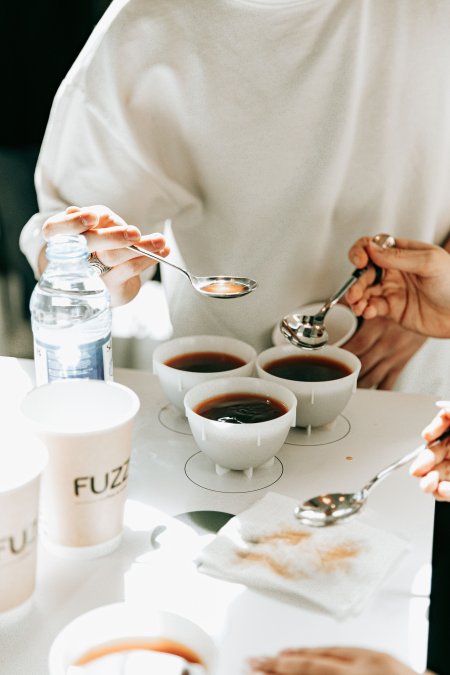
The right setup makes tasting easier. You do not need a lab. You need a clean surface, good light, and a few simple tools.
What You'll Need
- A deep-bowled cupping spoon, like the Cupping Spoon, made for slurping
- Two or three identical cups or bowls
- A notebook and pen
- A glass of water to reset between sips
- Freshly ground coffee, weighed and consistent
Weigh your coffee. Use the same dose and water for every cup you compare. If your brew varies, your tasting notes will too.

How to Identify Acidity in Coffee Without Guessing
Acidity in coffee is not the same as sourness. Acidity is the bright, lively quality that makes a cup taste juicy and alive. Sourness is a defect, a sharp, unpleasant bite.
Think of it this way:
- Good acidity: citrus, berry, apple, wine-like brightness
- Bad acidity: vinegar, unripe fruit, harsh sting
Coffee Flavor Wheel Explained: From Broad to Specific
The coffee flavor wheel explained in one line: it is a map that starts broad and narrows to specific notes. You begin at the center with big categories, then work outward to precise descriptors.
Here is how to use it:
- Start with the broad family: fruity, nutty, floral, spicy, sweet
- Narrow it down: fruity becomes berry, then blackberry
- Get specific: blackberry becomes jammy or fresh
Coffee Tasting Notes for Beginners: Building Your Vocabulary
Coffee tasting notes for beginners should start simple. You do not need fancy words. You need words you can actually remember, reuse, and attach to a real memory. The goal is not to sound like a professional. The goal is to build a mental library you can match against what is in the cup.
Start With a Reference Library, Not a Word List
Most guides hand you a list of adjectives. That is backwards. Words are useless without a smell attached to them. Build the smell first, then the word.
- Fruit: lemon, orange, green apple, strawberry, blueberry
- Nut and seed: almond, hazelnut, peanut
- Sweet: honey, caramel, brown sugar, maple syrup
- Floral and tea: rose, jasmine, black tea, chamomile
- Roast and cocoa: cocoa powder, dark chocolate, molasses
The Tasting Journal Template
A journal turns random sipping into structured training. Use a simple four-column format for every coffee you taste:
Field |
What to write |
Example |
|---|---|---|
Aroma (dry) |
What you smell before water |
"Cocoa, dried fig" |
Aroma (wet) |
What you smell after water hits |
"Brown sugar, orange peel" |
Flavor |
Broad family first, then specific |
"Fruity → berry → blueberry" |
Finish |
Length and quality |
"Long, sweet, clean" |
A 7-Day Palate Training Plan
You do not need a cupping lab to train. You need seven short sessions. Ten minutes a day is enough.
- Day 1, Smell only. Brew one coffee, smell it dry and wet, write the aroma fields. Do not taste yet.
- Day 2, Basic tastes. Taste the same coffee and name only sweet, sour, bitter, salty, umami. Ignore flavor notes.
- Day 3, Reference matching. Smell three items from your library, then taste the coffee and pick the closest match.
- Day 4, Two coffees, one variable. Taste two coffees from the same roaster. Write only the differences.
- Day 5, Finish focus. Taste one coffee and time how long the aftertaste lasts. Note whether it is clean or muddy.
- Day 6, Blind. Have someone pour two coffees without telling you which is which. Write notes before you find out.
- Day 7, Review. Read your week of entries. Circle the words you used more than once. Those are your real vocabulary.
Why Specific Memories Beat Generic Terms
If a coffee reminds you of your grandmother's lemon bars, write "grandmother's lemon bars" instead of "citrus." Specific memories are stickier in the brain and easier to recall the next time you taste something similar. Over weeks, your list grows. Your vocabulary grows with it.
The 5-Step Tasting Method: Slurp, Hold, Breathe, Compare, Repeat
The 5-step method is the fastest way to taste coffee flavor profiles with real consistency. Slurp, hold, breathe, compare, repeat. Each step trains a different part of your perception.
Step 1: Slurp Loudly
Slurping is not rude. It is technique. Pull the coffee in fast and hard so it sprays across your whole palate.
Step 2: Hold and Coat Your Palate
Let the coffee sit for a second or two. Move it around your mouth. Coat your tongue, the roof of your mouth, and the inside of your cheeks.
Step 3: Breathe Out Through Your Nose
Swallow, then exhale slowly through your nose. This is called retronasal tasting, and it is where most flavor lives.
Step 4: Compare Two Coffees Side-by-Side
Tasting one coffee alone is hard. Tasting two together is easy. Differences jump out when you have a reference point.
Step 5: Track the Finish
The finish is what lingers after you swallow. It can be short, medium, or long. It can be clean or muddy.
Troubleshooting: When the Cup Doesn't Match the Bag
The bag says "stone fruit and cocoa." You taste nothing. This happens to everyone, and it usually has a fix.
Check these variables first:
Problem |
Likely Cause |
Fix |
|---|---|---|
Flat, dull cup |
Old or stale beans |
Use beans roasted recently |
Sour, sharp bite |
Under-extraction |
Grind finer, brew longer |
Bitter, harsh |
Over-extraction |
Grind coarser, shorten brew |
No aroma |
Coffee too cool |
Taste between 160-180°F |
Muddy flavor |
Dirty equipment |
Rinse gear thoroughly |
Conclusion
Learning how to taste coffee flavor profiles is not about having a special gift. It is about slowing down, using a repeatable method, and comparing cups side by side. Do that for a few weeks and the notes will find you.
Frequently Asked Questions
What are the main flavor profiles of coffee?
Coffee flavor profiles fall into a few broad families: fruity (citrus, berry, stone fruit), floral, nutty and cocoa, caramel and brown sugar, and earthy or savory. Most specialty coffees land in two or three at once. A washed Ethiopian might read as floral and citrus, while a naturally processed or anaerobically fermented lot can push into berry, tropical fruit, or wine-like territory. The flavor wheel organizes these families so you can move from broad category to specific note as your palate develops.
How do you train your palate to identify coffee notes?
Taste the same coffee repeatedly and write down what you notice, even if it sounds odd. Compare two coffees side-by-side so differences stand out. Try a discovery set with the same producer and different processes, which isolates what fermentation adds. Smell dry grounds before brewing, then again after. Over a few weeks, your vocabulary grows because you have anchors to compare against, not because your tongue changed.
What is the difference between acidity, body, and flavor in coffee?
Acidity is the bright, juicy sensation you feel on the sides of your tongue and the roof of your mouth, like biting into a green apple. Body is the weight and texture, from thin and tea-like to heavy and syrupy. Flavor is the actual taste identity: chocolate, citrus, floral. All three show up in every cup at different intensities. A coffee can be high-acid and light-bodied, or low-acid and heavy-bodied, and both can be excellent.
How does fermentation affect coffee flavor profiles?
Controlled fermentation changes which compounds develop in the bean before roasting. Anaerobic fermentation, where beans are sealed without oxygen for a set number of hours, tends to push fruit notes forward and add complexity like tropical fruit, wine, or spice. The same producer's washed and anaerobic lots from the same harvest can taste dramatically different. That is why a discovery set with matched origins is useful: you taste the process, not the origin.